npm Staged Publishing and 2FA: New Defenses Against Supply-Chain Attacks – and Why Email Authentication Is the Foundation
npm Raises the Bar for Package Publishing Security
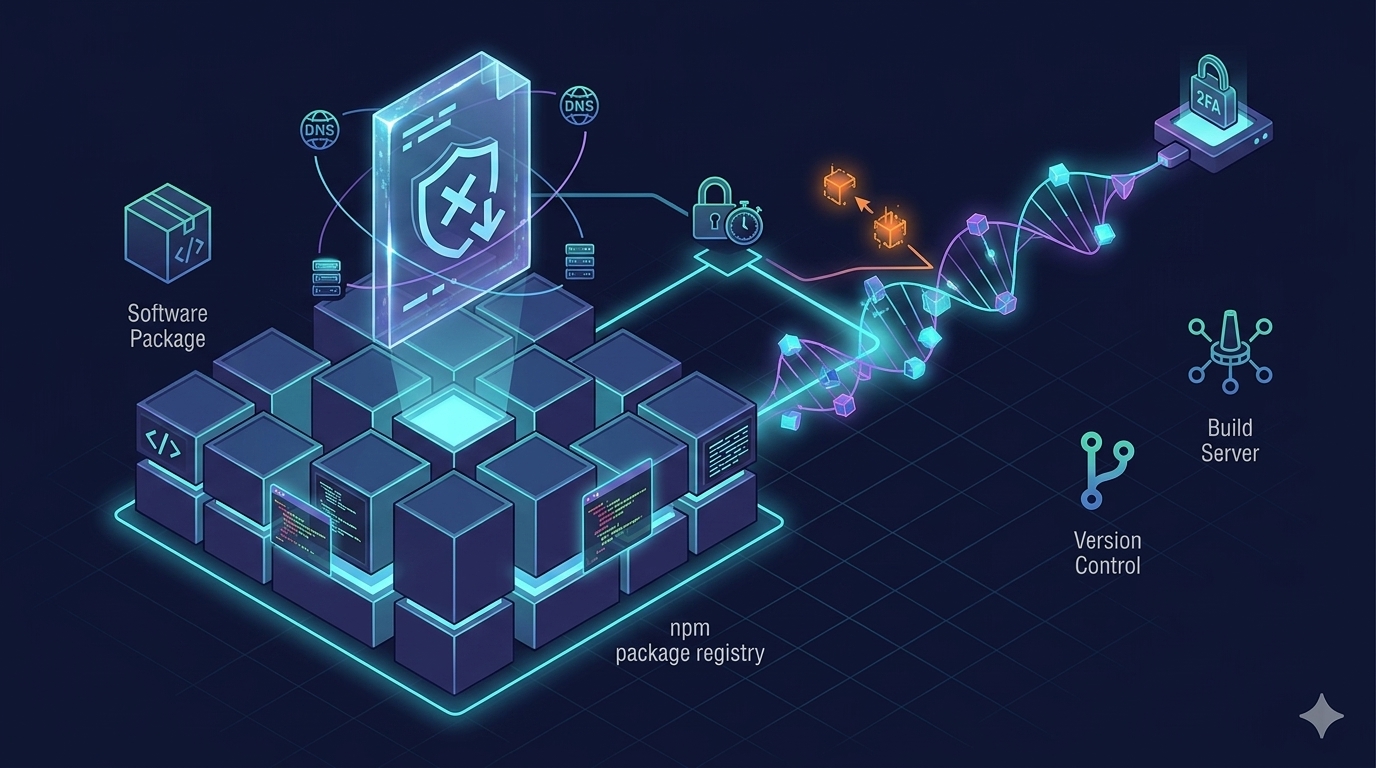
npm has introduced two new mechanisms designed to make supply-chain attacks significantly harder: Staged Publishing and 2FA-gated publishing. Maintainers now go through a two-step process before a package becomes publicly visible — and at a critical point in that process, they must confirm a two-factor authentication code.
On the surface, this looks like a platform-level technical change. But there is an underlying vulnerability that many teams miss: if the email authentication on an npm account’s domain is not properly configured, 2FA cannot deliver its full protective value.
What Is Staged Publishing — and How Does 2FA Gating Work?
In the classic npm publishing flow, a package lands in the public registry immediately. Staged Publishing holds the package in an intermediate state. Only when the maintainer actively confirms the release step — including a 2FA code — does it go live.
This gives maintainers a short window to:
- roll back unintended releases,
- interrupt automated attacks against compromised accounts,
- and add a human checkpoint to CI/CD pipelines.
The 2FA gate triggers at the most critical moment: the actual publish action, not just the login. An attacker who steals an npm password can no longer publish a package with that credential alone.
The Underestimated Role of Email Authentication
Here is the part that most DevSecOps teams overlook: in many setups, 2FA codes are delivered by email. That applies to npm notifications, password reset links, and account confirmations.
If the domain from which npm sends these emails does not enforce DMARC — or if the recipient account sits on a domain without properly configured SPF and DKIM — real attack vectors open up:
- Phishing for 2FA codes: An attacker spoofs an npm notification and redirects the developer to a fake confirmation page. Without DMARC enforcement on the sending domain, that email is nearly indistinguishable from a legitimate one.
- Account takeover via password reset: Reset links arrive by email. Anyone who can manipulate email delivery bypasses 2FA entirely.
- Man-in-the-middle on unprotected mail servers: Without MTA-STS and TLS-RPT, email transit can be intercepted or tampered with before the 2FA code ever reaches the developer.
This is not a theoretical scenario. Supply-chain attacks like the SolarWinds compromise or the ua-parser-js hijacking showed that attackers deliberately target the weakest link in the chain — and email is often that link.
What Maintainers and Teams Should Do Right Now
For npm maintainers:
Enable 2FA on your npm account — not just for login, but explicitly for publishing actions. npm allows granular 2FA requirements. Use Staged Publishing as soon as it becomes available for your account.
On the email side:
Check the domain through which you receive npm notifications. Is SPF correctly set? Is DKIM active? Is DMARC set to p=quarantine or p=reject? If not, the 2FA code landing in your inbox is potentially vulnerable.
The same applies to npm’s own sending domain: reputable platforms like npm enforce DMARC — but you can verify this yourself with a DNS lookup on _dmarc.npmjs.com.
For MSPs and IT admins managing developer teams:
Make sure your clients’ email domains have DMARC, SPF, and DKIM properly configured. A developer whose corporate email domain lacks DMARC enforcement is an open door — regardless of how well npm itself is secured.
DMARC Is Not a Dev Tool — But It Is a DevSecOps Enabler
It is tempting to dismiss DMARC as a pure IT security topic with no relevance to software development. npm’s Staged Publishing and 2FA gating prove the opposite: modern DevSecOps workflows depend on email communication. Deployment notifications, CI/CD alerts, package release confirmations — all of it runs through email.
If those emails can be spoofed or intercepted, the best 2FA mechanism is only as strong as the weakest email configuration in the chain.
A concrete example: a developer receives a spoofed npm email with the subject line “Action required: Confirm your package release.” The email looks identical to a genuine npm notification. Without DMARC enforcement on the sending domain, it lands in the inbox without issue. The developer clicks, enters their 2FA code on a phishing page — and the attacker has everything they need.
With DMARC p=reject on the npm sending domain, that email never reaches the inbox.
Two Controls That Belong Together
npm Staged Publishing and 2FA gating are sensible, long-overdue measures. They close a real gap in the publishing process. But they only work reliably when email authentication — on both the sending and receiving side — is solid.
DMARC, SPF, DKIM, MTA-STS, and TLS-RPT are not optional extras. They are the foundation on which 2FA-based security mechanisms can actually function.
Check whether your domain provides that foundation right now: Free domain check at DMARCPulse